RayGen's PV Ultracombines the best of other solar technologies to deliver the superior products.
In 2014, RayGen set a world record of 40.4% efficiency during a technology trial with the University of New South Wales.
Gallium Arsenide Super Efficient Solar Cells
The Australian University of New South Wales (UNSW) in 1985, invented a Super efficiency Gallium Arsenide Solar Cell, these are multiple layered PV cells that converts more rays of Sun's energy efficiency up to 40%. This world record was set by Dr Mark Keevers and Professor Martin Green, Senior Research Fellow and Director, respectively, of UNSW’s Australian Centre for Advanced Photovoltaics, using a 28 square centimetre four-junction mini-module – embedded in a prism – that extracts the maximum energy from sunlight. It does this by splitting the incoming rays into four bands (light spectrum’s), using a hybrid four-junction receiver to squeeze even more electricity from each beam of sunlight. There are two different types of Cells being developed using Gallium arsenide, instead of Silicon, where Two of these 10cm (4") Gallium Arsenide Solar Cell replace approx. 10 conventional 400W Solar Cells (4'000W÷400=10 panels), and 1m2 of Gallium arsenide Cells Harvests 220kWh (0.22MWh) of Energy, where a 4m2 PV Unlta cell Generates 1MWh of Energy & .
In 2025 RayGen Technology Developed a New Unique Energy Storage System;
They are now Storing the continuous flow of 90°C Hot Water, after it Cools the Gallium Arsenide Solar Panel in the Solar Towers.
4MW solar and 2.8MW / 50MWh storage. Four solar towers each generate 1MW of electricity and 2MW of heat. Two 17,000m3 Water pits store enough thermal energy to drive a 2.8MW ORC Turbine for 17+ hours (50MWh). The project saves 10,000 tonnes of CO2 emissions annually and provides low-cost renewable electricity day and night to approximately 1,000 homes.
What is ORC Turbine ?
ORC is an Organic Rankine CycleTurbine generator, a system that converts low-to-medium temperature heat into electricity using an Organic fluid instead of water. The process involves heating the fluid to create a high-pressure vapour, which expands through a turbine to spin a generator and produce power. This is useful for waste heat recovery from sources like geothermal, biomass, or industrial processes where traditional steam turbines would not be efficient.
How ORC Works;
Heating: A heat source, such as geothermal or waste heat, transfers energy to an organic fluid (with a lower boiling point than water) in an evaporator.
Expansion: The organic fluid boils, creating a high-pressure vapour that drives a turbine, which is connected to a generator to produce electricity.
Condensation: After passing through the turbine, the vapour is cooled and condensed back into a liquid.
Pumping: A pump sends the liquid back to the evaporator to restart the cycle again.
Advantages;
Lower temperatures: It can operate with heat sources at lower temperatures than traditional steam turbines.
Efficiency: It can be very efficient for waste heat recovery and is well-suited for lower-temperature applications like geothermal energy.
Reduced wear: The lower operating pressures and slower turbine speeds can reduce wear and tear on the components.
Flexibility: ORC units can be installed as pre-assembled, skid-mounted systems that are easily transported and installed.
Commercial Applications;
Raygen Story 2025
Raygen Story 2024
RayGen NEWS April 2025;
One of the largest clean energy technology capital raises in Australian history.
Growing pipeline and manufacturing plans attract new investors.
SLB, Breakthrough Victoria, Quanta Services, Oxy Technology Ventures, Equinor Ventures, AGL Energy, Photon Energy Group and ARENA back RayGen in its Series D investment round.
Australian utility-scale solar and long duration energy storage company RayGen Resources today announced the closure of its latest capital raise, with existing and new backers committing A$127 million of funding to the company.
Global technology company SLB led the round with a A$31 million follow-on investment and the execution of a RayGen-SLB Strategic Deployment Agreement (SDA), designed to accelerate the technology's path to the global energy market.
New investors in Series D include infrastructure project delivery leader Quanta Services, Oxy Technology Ventures and, as previously announced, Breakthrough Victoria, a private investment company for Victoria, providing patient capital and impact investment to the State's economy.
Equinor Ventures, AGL Energy and Photon Energy Group, alongside other existing shareholders, have also followed up their previous investments. The Australian Renewable Energy Agency (ARENA) continued its vital support with an additional A$17 million boost to the A$10 million funding agreement announced last year.
RayGen CEO Richard Payne said his team was invigorated by the industry-wide support in this latest investment round.
"This new funding round validates our vision, empowers us to accelerate our growth and is recognition of the outstanding effort and dedication of the RayGen team," Mr Payne said.
"Beyond their funding commitments, the calibre of our strategic investors places RayGen in an unrivalled position as we continue to drive local and international technology deployments.
"It also enables us to continue to play an important role in Australia's energy transition and pioneer innovation to help us achieve our climate goals.
"This is already an Australian success story; our mission now is to deploy this technology to the world."
A spokesperson for lead investor SLB said the company was proud to continue its support and was excited by the international potential created by the SDA.
SLB Vice President, Renewables & Energy Efficiency, Irlan Amir, said: "We believe RayGen's next-generation solar thermal hydro energy storage technology can provide clean and flexible energy to address the intermittency challenge of renewable energy. We look forward to deploying their solutions on a global scale."
ARENA CEO Darren Miller said: "This is a testament to a decade of innovation, collaboration and hard work by RayGen.
"RayGen's journey to enhance the efficiency and sustainability of renewable energy has provided valuable insights into the practical applications of innovative energy solutions and is a true testament to Australian ingenuity.
"RayGen's technology represents a significant advancement in renewable energy solutions. Its work in solar-and-storage will have a substantial impact on the global energy landscape and ARENA is proud to have been there almost every step of the way."
AGL Chief Operating Officer Markus Brokhof added: "This investment builds on AGL's existing relationship with RayGen which includes an offtake agreement for production from RayGen's Carwarp Power Plant. Electricity generated and stored at Carwarp is already being supplied to AGL customers.
"AGL has long been an early supporter and adopter of innovative energy solutions like RayGen's, and we believe this technology has the potential to be deployed at greater scale and could be one solution to the challenge of long duration energy storage."
RayGen's solar-and-storage solution addresses the growing need for long duration energy storage to balance intermittent wind and solar power in global energy systems as fossil fuel generators are decommissioned.
The RayGen system uses mirrors to concentrate sunlight onto Australian-made, highly efficient solar modules. In addition to producing electricity, heat is captured from the modules and stored in water reservoirs for on-demand electricity dispatch via a synchronous engine.
The company's flagship asset at Carwarp, Victoria, is one of the world's largest operating next-generation long duration energy storage projects and is under an offtake agreement with AGL.
The additional investment comes as RayGen's modular, integrated design for hi-tech solar and thermal hydro storage is being considered for multi-GWh projects.
Partnering with Photon Energy Group, a development application has been submitted for a 150MW project at Yadnarie, on South Australia's Eyre Peninsula. Photon Energy has also announced the development of a 250MW RayGen project in South Africa.
Last year, the company opened Australia's largest renewable energy manufacturing facility, a 170MW per annum solar module production line in Melbourne.
--- /// ---
Below is OLD NEWS !
Comparison with Silicon PV
In 2017 the ultra-high efficiency module RayGen used, was nearly twice as efficient when compared to traditional silicon PV panels (up to 38% compared to 23%), the light is focused over 600 times, by mirrors onto the PV Ultra panel in the receiver. The PV Ultra panel produces over 4000 times the electrical power vs regular silicon photovoltaic panels of the same area.
This means that PV Ultra is much more value intensive. Standard photovoltaic systems require 6,000m2 of flat panels per MW. PV Ultra uses 3,600m2 of mirrors and just 4m2 of photovoltaic material per MW. That’s right – every square metre of RayGen modules can produce 250kW of electricity, and that’s before considering over 400kW of heat energy.
Both Silicon PV and PV Ultra systems require the same land area – however optimised Dual Axis-solar Radiation tracking (DART) Field can increase Energy yield by 60% per year vs Fixed Racking PV. Heliostat's are wireless and raised off the ground, and DART's both enabling dual land use, such as Grazing or Crops.
Because the mirrors and tower are made using existing technology drawn from automotive and electronics manufacturing, a PV Ultra installation can have a far higher level of local content than imported solar panels.
Comparison with Concentrated Solar Power (CSP)
PV Ultra also has clear advantages over Concentrated Solar Power (CSP).
Like CSP, PV Ultra collects the sunlight using heliostat's focuses light onto a PV Ultra Gallium Arsenide Solar Tower, but that is where the similarities end. Where CSP uses a thermal receiver and complex, expensive heat turbines that require a lot of maintenance, PV Ultra uses a photovoltaic cell that requires little maintenance and upkeep.
To be efficient, CSP requires tall, massive towers over 150m high (similar to a sky-scraper over 50 stories high).
By contrast, PV Ultra’s tower is thin and less 45m high (similar to a standard light tower). RayGen has already demonstrated its commercial efficiency at 1/4MW.
Comparison with Concentrated Photovoltaic (CPV)
PV Ultra has several advantages over CPV.
All of the high-tech semiconductor components (modules) are all contained in the small factory built ‘receiver’. The collector field is aligned to the receiver with software, not hardware. This means that manual field alignment is not required, software correction allows low precision hardware and low precision installation, and manufacturing tolerances can be higher.
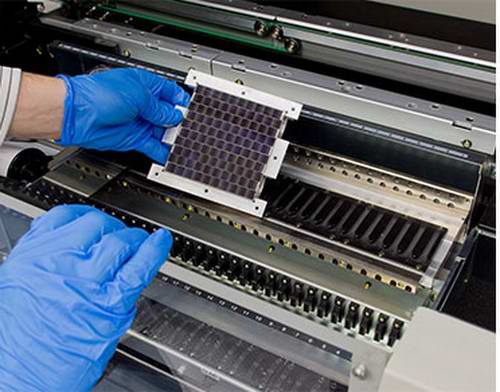
The manufacturing processes for the cell modules and heliostat's use existing automation technologies currently used in industry – automotive manufacturing techniques and facilities for the heliostat, and standard electronics manufacturing for the cell modules. This means that PV Ultra delivers reduced cost to scale, equipment is pre-fabricated and installation is rapid, labour costs are lower, and leverage existing automotive and electronics manufacturing makes it easy to meet local content requirements.
A 1MW receiver with a dense module array is just 4m2. This allows for easy shipping, upgrades of new modules, centralised heat management system enabling heat sales, centralised power conversion that eliminates field wiring, and optimised flux management that enables constant flux.
Remember: Gallium arsenide Solar Cells are up to 38% efficient at Generating energy from the sun, where quality Monocrystalline solar cells are currently around 23% efficient.
Actual size of a 2kW Gallium Arsenide Super Cell is (approx. 10cm x 15cm) shown above next to a business card.
Each layer of a four-junction cell extracts energy at its most efficient wavelength, while unused light passes through to the next layer.
First 220kWh Gallium Arsenide solar farm, built in Victoria, Australia.
220kW with 68 Heliostat mirrors array.
200kW Array Tower is 20mt high.
1MW Array will require 45mt Tower.
Heliostat mirrors focus the suns rays onto the Tower Concentrator Head.
100 Super Cell Head =200kW, is only 1m2.
400 Super Cell Head =1MW, is only 4m2.
Heliostat mirror focus the suns rays 365 times there strength onto the Tower.
68 self-powered, self-aligning Heliostat's.
Self powered mirrors create a wireless field, creating a cheaper and simpler install.
a 2kW Cell size is amazingly small.
2kW Cell R&D Heat sink.
2kW Cell & Copper R&D Heat sink.
2kW R&D Cell Testing Temperature.
Hydraulic unit for raising & lowering of the Tower for maintenance.

.jpg)
 and
and 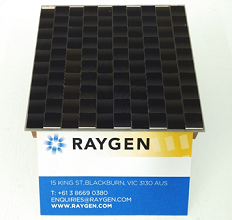

.jpg)
.jpg)
.jpg)
.jpg)
.jpg)
.jpg)
.jpg)
.jpg)
.jpg)
.jpg)
.jpg)
.jpg)
.jpg)
.jpg)
.jpg)
.jpg)